Sunday, 19 September 2010

Meeting friends from Norwegian newsrooms

I had the pleasure of meeting a group of print and broadcast journalists from Norway who dropped by the Post&Echo offices on Friday, while they were on a union-led, team-building outing to Liverpool.

Lars Johnsten, of Drammens Tidende, contacted me to suggest meeting up after a mutual acquaintance (whom I first met and admired on Twitter before making Real World contact at the News Rewired conference earlier this year), journalist and blogger Kristine Lowe, hooked us up.
And I'm so glad she did. 

It was fascinating to talk about the issues and developments in the industry, and get their take on things - cutbacks, newspaper ownership, paywalls and what (if any) content you could conceivably charge for. Lars' paper has just developed an iPad app and I will be very interested to see how that takes off. Likewise, they were interested to know how the newsroom operates having taken out a production tier, with reporters writing onto electronic pages and no sub editors. 

I snapped a quick photo of some of them discussing Saturday's front page design with editor Alastair Machray and designer Richard Irvine...

Norwegian journos visiting the Echo

It brought home to me - yet again - how my work as a journalist, and my day-to-day job - has been enriched by social media. Without Twitter and blogging, we would never have had that point-of-contact and this random meeting - which really enlivened a Friday afternoon - would probably have never happened.
It's a small point, but it's one I do well to remind my self of. And it's a nice example to have up my sleeve if I'm asked (as still occasionally happens) what the returns are for the time invested in social media. Making real life friends is a pretty good return, I'd say.
Enhanced by Zemanta

Thursday, 16 September 2010

No laughing matter...

Mistakes happen. Twenty years on I still remember the Editor's Hairdrier I got for leaving the letter 'l' out of a front page news story on public rail works, and I have (occasionally) felt a little swell of gratitude for Microsoft Word after its suggestions saved my blushes.
But this little slip was too good not to save and - now that some months have passed - share. It's from one of my local weekly papers and it did make me smile...


 ...Which is more than can be said for George's leg, I guess.

Wednesday, 1 September 2010

Getting over a blogging breakdown

Dear Blog, 

I'm sorry I've been away; it's not that I don't care, it's just that I have had very little to say for myself and you, Blog, are partly to blame for that.
You see, when I first hooked up with you and gave you your name, I also saddled you with a mission statement - the rather ponderous
Thoughts on changing times for journalism and newspapers that still sits just beneath your title today (although that may change soon). And lately I haven't had many thoughts about journalism or newspapers, at least not any that would stand sharing.

Because recently, Blog, I have found it increasingly hard to negotiate the choppy waters of 'changing times'; I have, if you like, lost my compass. I have striven to be optimistic about newspapers and the future but sometimes the words rang very hollow indeed.

Like, I'm interested in data journalism, visualisations and applications but I don't think it's the sole rock on which a business should be founded. I'm interested in apps but I think probably mobile web is just as important if less headline-grabbing, I'm interested in story-telling yet I'm bored of big reads - but if you hit me with nothing but headlines and push Slow Journalism off the page, I feel superficial and guilty that I don't care enough to read 3,000 words of deathless prose.

So I'm afraid I've been ignoring you, Blog, but if it makes you feel better, you aren't the only one. I deserted my other online playgrounds too - even the BFF ones like Twitter, and Google Reader, and Delicious. Not only did I have nothing to say, I didn't want to hear anything interesting from anyone else either. Because it might not make a difference to how I felt, and that would mean that the estrangement was probably going to become permanent. 

What changed things was, randomly, a delayed hair appointment. I was stuck in a coffee shop with wifi, waiting for the clock hands to move, when I logged onto Twitter and instead of my recent lurking, I gatecrashed a conversation between Nigel Barlow, Jo Wadsworth and Andy Dickinson. The subject interested me, and within a few tweets the conversation had grown to include thoughts from Glyn Mottishead, Sue Llewellyn, Sam Shepherd and Mary Hamilton. 

It grew into a really interesting debate - the type of thing you'd like to move into the real world and accompany with some ale - and it reminded me how valuable my online networks people and conversations are to me. It reminded me, Blog, that I started you so I could have conversations with myself and others about journo stuff I was trying out, and thoughts or half-baked ideas I'd had; I realised that going dark was just another way of sulking because the Utopia I had in mind when I started blogging in 2008 hadn't panned out. 


The Panning Out is still going on, and it's going to continue for a long time - in fact, it's never going to stop. It will just move on to the next thing, and the changes will keep happening. The trick is not to start longing for and end to change, I guess, because newspapers and journalism stopped changing for a long time and that is, in part, what's led to the current crisis. 


Anyway, Blog, that's all I wanted to say. I'm sorry I stopped talking to you, and I hope we can move on from our brief falling out. If it makes you feel better, I had a catch up with my mate Neil MacDonald earlier and he revealed, unprompted, that he'd had a blogging crisis and had ground to a halt. I see he's over it now though. I'm not quite, but I think I'm getting there. 


Love always, 
Alison


Enhanced by Zemanta

Wednesday, 18 August 2010

Site searches - tttttttttttttttttttttttttttttoo baffling for words

Several times a day, an automated message drops into my inbox telling me the most searched for terms on the Liverpool Echo site.
It's an idea we appropriated from the Manchester Evening News a while ago and, as well as just being an informative overview of what users are looking for, it's proved popular with newsdesk types as it can give a heads-up on a story we don't know about.

We use analytics all the time to look at what is popular on the site, but the automated search-terms round-up will often flag up a name that's being repeatedly searched for; if we don't recognise that name, it may well be connected to a news story - we've found out the names of fatal rta victims before they were released by the police through friends searching for the story by name on the site.

We've also had some random ones - The World being searched for in the latest one is a cruise liner that visited Liverpool at the weekend but how do you explain the phrase 'knicker sniffer' being the top searched for term on the site recently? There wasn't a court case because we checked, but there were dozens of searches for it. Police could offer no enlightenment either... but I bet there will be a court case coming up in the near future involving that term (although probably in slightly more legalese).


But today's is a little baffling:


That's 'tttttttttttttttttttttttttttttttttttttttttttttttttttttttttt' and 'tttttttttttttttttttttttttttsssssssssssssss', just to be clear. No way it could be a repeated, random elbow on a keyboard surely? But we've puzzled and come up blank. Answers on a postcard please.

Enhanced by Zemanta

Thursday, 12 August 2010

TBC.com could be an inspiring approach to hyperlocal news

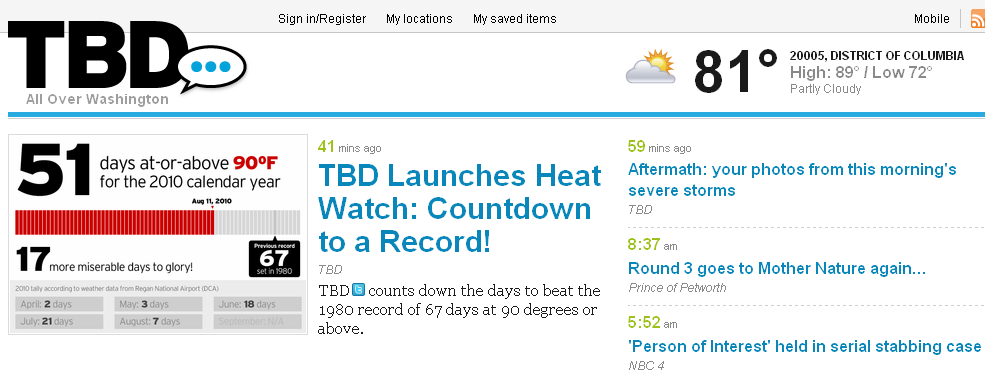
I nosed around the newly-launched TBD.com website today, and came away a bit of a fan-girl.
TBD, which is from the same brains as Politico, is a real foray into hyperlocal journalism and could just be one of the models the rest of us in mainstream media end up emulating.


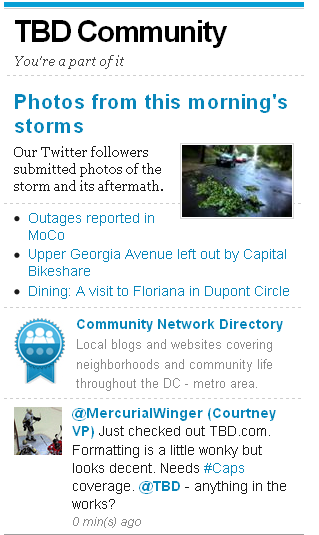
It offers local news and community information from Metropolitan Washington DC, has reporters, editors, producers, and 'community-outreach specialists' (a  new one on me) to produce original journalism, curate news from other media - mainstream and independent (I'm including local bloggers in independent media; after all, they're creating content) and engage audiences. 

There's a detailed review of the site and its genesis on the Huffington Post (see the links at the bottom of this) but I don't agree with their idea that journalists will be watching this with concern. I think a lot of us will be looking at it and thinking 'that's exactly what we need to do'. Ultimately, it could inspire better things.


It’s very new but already I really like this site, both from the point of view of a journalist and that of a user; it’s how I think local news company websites should aim to operate. I can certainly understand why US industry watchers say the Washington Post is eyeballing it. 


I like it as a journalist because:
  • It’s seriously packed with news, features and information
  • It’s packed with news happening right now (truly  - the homepage splash changed every time I reloaded the page)
  • It updates constantly
  • It has loads of sources of information - both from TBD staffers, mainstream media, social networks, bloggers and users
  • It’s an active site - doesn’t rely on feeds/UGC
  • It ‘gets’ hyperlocal
  • It does live fact-checking


I like it as a user because:

  • It’s easy - news, features, sport and essentials. Plus a great site map.
  • No flashing ads, no massive rollovers, no banners with tiny close signs
  • Pithy articles, eye catching video, good images
  • It lets me choose my local news
  • Live fact-checking (yes, its still great)
  • Excellent commuter information
  • I feel involved
  • It’s thought about what mobile apps users might value


In fact, the more I wandered around the site the more I found to like. It doesn’t have a big news corporation feel to it, and maybe that’s what’s so attractive. It offers the slick, polished set up of a MSM company without feeling unwieldy and over-designed. I think the residents of Metropolitan Washington DC are very lucky.


Enhanced by Zemanta

Thursday, 5 August 2010

Graphs, charts and tools to monitor your Twitter growth and reach

After Hanoi-based Steve Jackson (@ourman) tweeted "Is there any online software that will turn your Twitter activity into a graph?" I had a look through recommendations he received in reply and I thought I'd give them a try, alongside some of the ones I use regularly, or ones I've stumbled across and meant to use.

Monday, 2 August 2010

Infographic: the information explosion

Lovely infographic to pore over here from Wikibon..
It forecasts consumer generated content, how it will impact on business - and where all this information will be stored.

The last section 'Who's responsible for the content' is particularly interesting;  if enterprise is responsible for the content created, they have to find a way of storing it (and a way of paying for that storage.Will the Library of Congress really be so keen to shoulder the burden of storing every tweet if the usage continues to grow (it's just notched up its 20 billionth tweet)?
The infographic highlights an IDC estimate that, in 10 years time, business transactions on the internet (B2B and B2C) will reach 450 billion per day. That is a boggling amount of data.


A final point (and far less boggling) is the US language and UK landmark mashup on this infographic which sees the pitch at Wembley Stadium becoming 'the field'...


Information Explosion & Cloud Storage
Via: Wikibon


Enhanced by Zemanta